
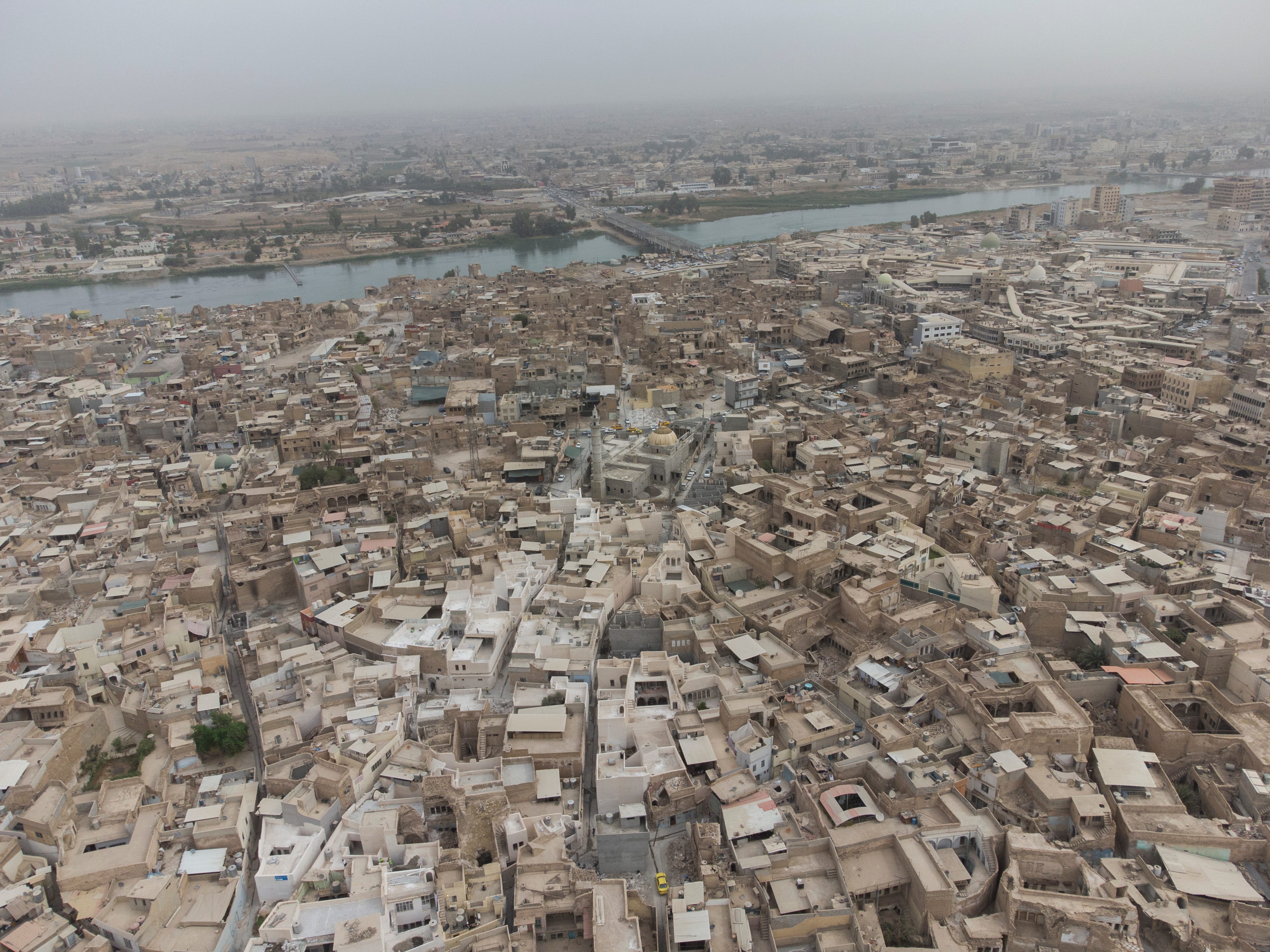
Restoring Mosul's Cultural Heritage - What Does it Really Mean?
Restoring cultural heritage is broadly seen as a positive and honorable task. In the context of post-conflict societies, it draws international attention and approval - it helps, it progresses, it localises, it heals. Yet this recognition remains vague and unsatisfactory and its actual impact may in many cases be hard to measure. How does heritage restoration specifically help local communities? Is it a top priority for communities tackling poverty and division? And do these communities share the opinion of international outsiders?
These questions are especially relevant to Mosul.
Following the huge civilian cost and desolation of 80% of the old city, UNESCO set up a $115 million ‘Revive the Spirit of Mosul’ campaign, to restore part of the old city. 2025 marked a year of significant heritage restoration with the completion of several large-scale projects. The reinstated presence of Al-Nuri Mosque, Al-Tahera Church and Al-Sa’a Church in addition to historic Ottoman houses, marks what many hope is the first step in returning to a brighter future.1
Cultural heritage, and its protection and restoration, is undeniably important. Indeed, it has long been seen as a means to assert a nation’s identity, culture, and collective memory. Dr. Timothy Clack considers that cultural heritage “anchors, orientates, and locates a person, a people, in time and space”.2 The highly targeted manner in which militant groups attack cultural icons attests to the sheer value they offer to a people - and the significant psychological impact their destruction can wield. Daesh’s campaign of malicious cultural “unfixing”’ has been recognised by certain scholars as a form of ‘culturecide’.3 Such direct targeting of a nation’s cultural heritage was not random, but rather reflected a deliberate policy of destruction and Daesh’s recognition of the inherent and intangible value such assets possess.
Although cultural heritage restoration forms an integral part of post-conflict development, there is however a dichotomy between external actors championing cultural restoration as the solution for conflict-affected communities, and failing to consult these same communities’ needs. This may in part be explained by human nature - after all, it is often easier for the international community to rally behind certain issues that may be more attractive during humanitarian crises, rather than less aesthetically-pleasing and more complex challenges post-conflict societies face. Rebuilding a society and repairing torn communities is undeniably more complex than rebuilding houses.
Larkin and Rudolf describe this phenomenon as ‘heritage as healing’, noting that it is a flawed approach critiqued for excluding local needs, and exacerbating social, sectarian and class divisions.4 They argue this approach favours ‘world heritage’ over local residential and economic needs, reifying divisions rather than reuniting communities, exacerbating class divides, and consolidating sectarian narratives and competitive territorial claims”.5
Although the restoration of buildings is perhaps a more satisfying objective to complete - involving a clearly visible goal, an achievable and demarcated time-frame, and a certain boasting right once completed, the ‘uglier’ problems that prove harder to tackle perhaps unsurprisingly receive less attention. Mosul faces severe challenges, including poverty, security and a chronic lack of infrastructure. Over 6 million Moslawis were forced to flee during the conflict; according to the BBC as of 2020, 1.3 million people remained displaced and 4.7 million live in severe conditions.6 Yet international rebuilding efforts merely skim over these significant issues, outlining the impact of cultural restoration projects in the broadest possible terms.
In a survey from The Conversation, Mosuli residents were asked questions regarding their city’s reconstruction. The top priorities identified were ‘safety and security’ (61%), ‘unemployment and poverty’ (54%), and ‘hospitals, health and sanitation’ (49%).7 Less than a fifth of citizens surveyed identified ‘heritage protection and reconstruction’ as a top concern.
These results identify a mismatch between international and local priorities that signal a wider dichotomy between external actors’ involvement in projects deemed to meet local needs. Unfortunately, this fits a well-established pattern in Iraq’s recent history. Tanvir Hasan, a conservation architect for the World Monument Fund in Iraq, outlines further how foreign heritage restoration in the country often fails to create a ‘middle ground’ of collaboration with local communities.8 Instead, projects rely heavily on Western aid and goals, failing to involve local organisations and utilise local tradesmen and skills.9 Yet in failing to involve local actors in their own communities, Western heritage organisations risk applying a short-term, ‘quick-fix’ makeover to severely devastated societies that fails any real, tangible long-term development.
This issue goes beyond Mosul and beyond Iraq, to illustrate a broader concern within heritage restoration. Articles such as ‘UNESCO’s quest to save the world’s intangible heritage’ by Julian Lucas for The New Yorker further echoes this hint of condescension. A long list of UNESCO’s achievements present the organisation as the sole protector of world heritage, whilst only briefly mentioning the drawbacks such accreditation brings. These include excessive tourism that may actually threaten the survival of the site itself.10 Moreover, cultural heritage efforts are viewed as benign acts of goodwill - obscuring the significant politicisation of organisations such as UNESCO and the power dynamics they exert on local populations. This narrative also obscures the West’s hallowed legacy in Iraq.
At times, UNESCO has been accused of prioritising heritage above all else. There is a growing list of sites spurned their world heritage status over urban planning that the organisation deems contrary to heritage preservation. In 2021, Liverpool’s Maritime Mercantile City was removed from the World Heritage List, due to development sites considered ‘detrimental to the site’s authenticity and integrity’.11 Many critiqued the move as illustrating a bifurcation between heritage restoration and genuine investment in communities. Liverpool City Region Mayor, Steve Rotheram, stated “Places like Liverpool should not be faced with the binary choice between maintaining heritage status or regenerating left-behind communities and the wealth of jobs and opportunities that come with it”.12
This is not to discredit or critique UNESCO’s work without acknowledging the immense value it brings. But heritage restoration must work with, and be informed by local considerations. That includes assessing how cultural heritage restoration should be conducted. Whilst 98% of Moslawis agree with the statement that ‘Heritage sites that were damaged or destroyed during recent conflict should be restored or reconstructed’ a strong theme that also emerges through polls is that local citizens prefer damaged structures be restored into functional spaces - rather than their previous historical condition solely.13
This sentiment appears to encompass what Hasan has described as a need to restore the city’s “living culture”, where restorations should benefit the local community in a meaningful way. Local residents report concerns over transforming al-Nouri Mosque into a tourist site that lacks an authentic connection to locals.14 In an interview with Meskell and Rudolf, a Mosuli activist notes, “the reconstruction of a site is not about the physical building, it’s about the rehabilitation of its spirit. And its spirit comes from the people. If they are not involved, this site will have zero value”.15
As David Sassine of heritage project Mosul Mosaic notes, the restoration of the Chaldean Catholic Al-Tahera church represents a direct effort to encourage social and religious cohesion in a post-conflict environment.16 Although Iraq’s diverse Christian community remains small, Sassine references an increased travel of Erbil-based Christians to visit the church. A young Christian from Mosul notes, ‘ISIS bombed every part that belongs to our identity. We are now left without an identity. We are bereft of our history’.17 Clearly, the church’s restoration has formed a positive chapter for the Christian community, in recovering from Daesh’s campaign of culturicide and creating an impact beyond a physical restoration alone.
Efforts to promote a living culture may also be seen with the formation of ‘Baytna’ - an arts centre in the Old City of Mosul, founded with the intent to connect youth to the city’s culture. Translating to “our house” the foundation comprises an art gallery, café, shop and book collection, hosting events aiming to promote co-existence and unity between Mosul’s diverse communities.18 Founder Saker Ma’an references how they work “together with youth, to make them aware of their cultural heritage”, stating simply that “Mosul really needed this place”.19 Ma’an’s quote lands on a pertinent point; namely, that cultural restoration should prioritise local connection to community and place. The example of Baytna demonstrates the authentic use of a beautiful building’s reconstruction as a social hub, rather than just glossy marketing to foreign audiences.
Beyond terms such as ‘local involvement’ and ‘grassroots collaboration’ which are often thrown around, it is therefore imperative that heritage reconstruction in Mosul centers and truly collaborates with local communities. That means considering heritage in a common-sense, holistic manner that does not over-inflate its importance compared to other pressing issues facing a post-conflict environment. Whilst the restoration of Mosul’s iconic heritage sites is undeniably a powerful statement - both visually and symbolically - heritage must also work in harmony with other efforts to tackle Mosul’s unique challenges. As local polling suggests, cultural restoration must also engage in creating functional spaces that bring people together. After all, a building is so much more than a physical space - it may represent an idea, a tradition, a people, and a city
.
UNESCO Courier: https://courier.unesco.org/en/articles/reconstruction-reconciling-past-and-future. Accessed 7 May. 2026.
Ibid.
Larkin and Rudolf. “Memory, violence and post-conflict reconstruction:rebuilding and reimagining Mosul.” Peacebuilding, 2024.
Ibid.
https://www.bbc.co.uk/news/world-middle-east-54873830. Accessed 15 June. 2026.
https://theconversation.com/mosul-faced-mass-heritage-destruction-by-the-islamic-state-we-asked-residents-what-they-thought-about-rebuilding-207725. Accessed 9 May. 2026.
https://www.bdonline.co.uk/opinion/heritage-and-post-conflict-reconstruction-in-mosul/5136900.article. Accessed 7 May. 2026.
Ibid.
https://ww3.rics.org/uk/en/modus/built-environment/homes-and-communities/is-unesco-world-heritage-beneficial.html. Accessed 15 June. 2026.
https://whc.unesco.org/en/news/2314/. Accessed 15 June. 2026.
https://www.bbc.co.uk/news/uk-england-merseyside-57879475. Accessed 16 June. 2026.
Isakhan and Meskell. “Rebuilding Mosul: Public opinion on foreign-led heritage reconstruction.” Cooperation and Conflict, 2023.
Larkin and Rudolf. “Iraqi heritage restoration, grassroots interventions and post-conflict recovery: reflections from Mosul.” Journal of Social Archaeology, 2023.
Ibid.
Larkin and Rudolf, 2023.
https://www.pinkjinn.com/2024/01/17/the-bytna-foundation-culture-community-in-mosul/. Accessed 16 June. 2026.
https://www.theguardian.com/world/2025/mar/02/mosul-iraq-islamic-state-mosque-reconstruction-ramadan. Accessed 12 June. 2026.


